
AI Improves the Case for Bitcoin
Why AI will make Bitcoin more attractive as a store of value
Right now, there is a duopoly in the market for a store of value. The first is gold, which has been a store of value for thousands of years. The second is Bitcoin, which has been around for less than two decades and has found its main purpose as a store of value only in the last several years. While gold is clearly the leader right now as a store of value, I'm going to argue in this article that Bitcoin will gain ground on gold because of AI.
The reason AI will improve Bitcoin's position as a store of value relative to gold is related to how AI is affecting the mining industry. According to Rick Rule, probably the most respected name in natural resource investing, AI's transformation of mining exploration is “enormous — and is happening today.” In a recent interview with Adam Taggart of Thoughtful Money, Rule described how AI can digest enormous geological databases and find the “coincident anomalies” — alteration, structure, geochemistry — that tell geologists where to drill. He illustrated the speed difference with his own work: analysis that used to take him six weeks as a young analyst, he can now have AI produce in about two minutes.
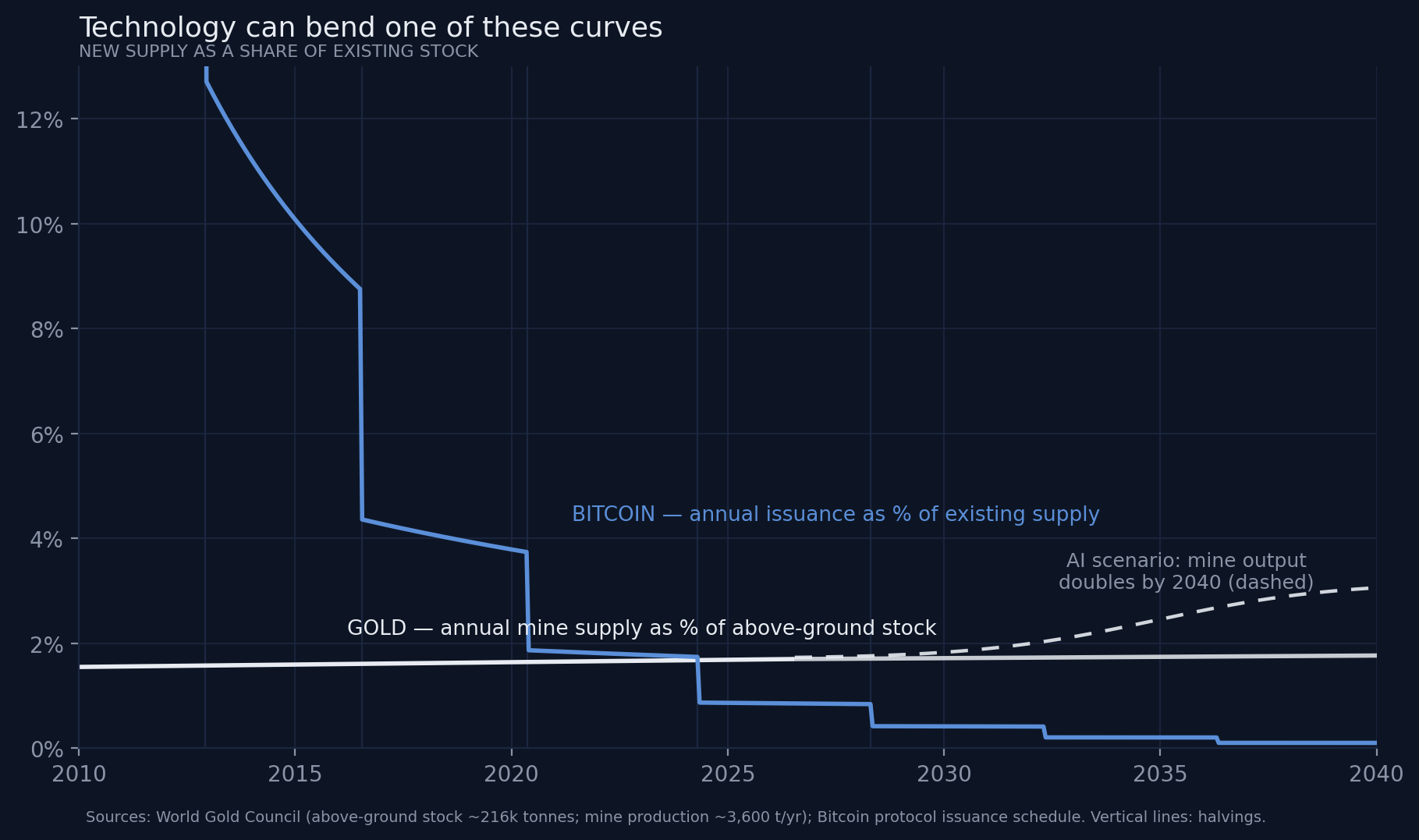
If AI drastically improves the efficiency of finding metals, this will increase the supply of metals over time. And as the supply of gold increases, its attractiveness as a store of value decreases. Right now, all of the gold ever mined fits into roughly 3.5 Olympic-sized swimming pools — about 216,000 tonnes, according to the World Gold Council. Here is the important arithmetic, though: mines add only about 3,600 tonnes a year to that stock, or roughly 1.7%. Even if AI eventually doubled the world's mine output — an aggressive assumption — gold's supply growth would still only be around 3.4% per year. The pools fill slowly. AI doesn't flood the market with gold; what it does is bend gold's supply curve in a way that was never possible before. Bitcoin's supply of 21 million coins, by contrast, cannot be bent by any technology. Its issuance schedule is fixed in the protocol, and better computers simply raise the mining difficulty rather than the number of coins. Gold's scarcity is a fact of geology and economics. Bitcoin's is a fact of mathematics.
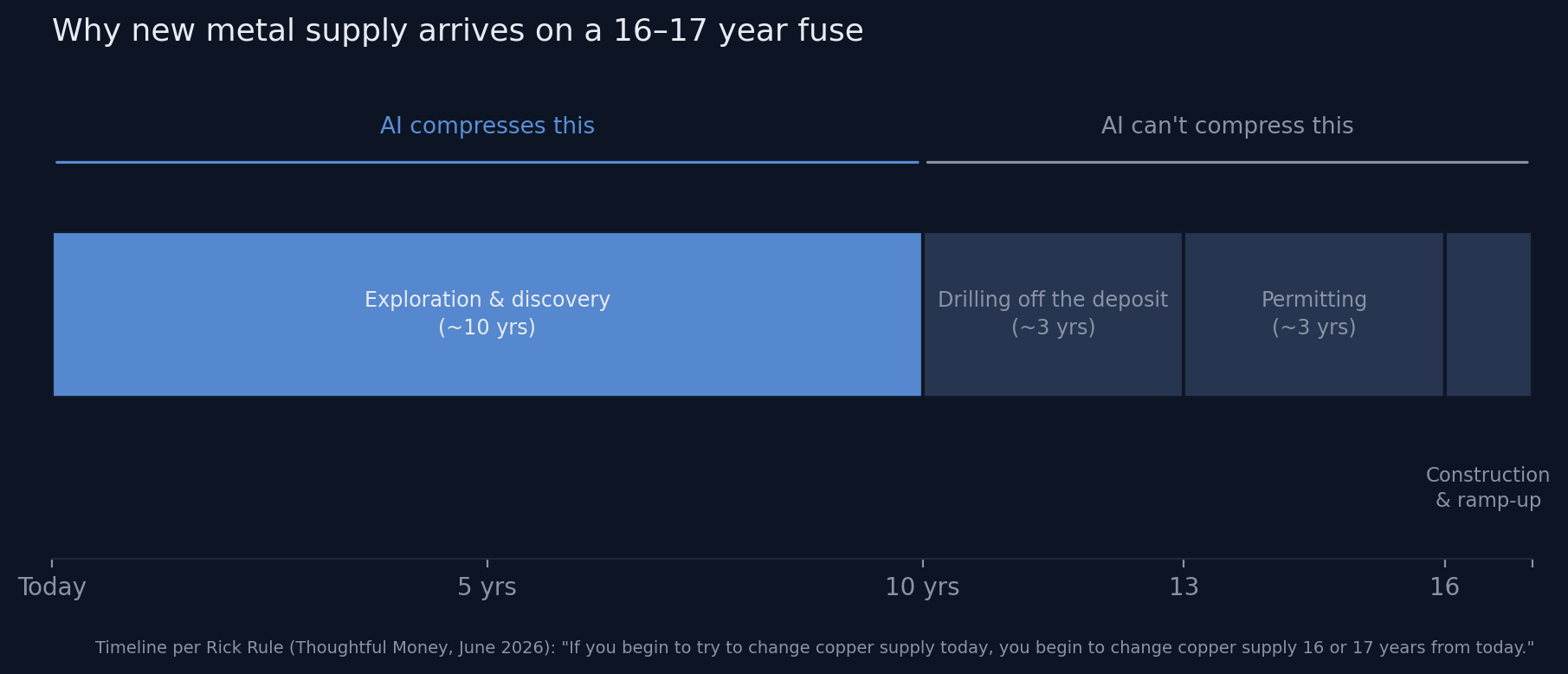
There is a second reason the gold supply response will be slower than the AI hype suggests: discovery is only the first step. Rule himself laid out the timeline in the same interview, using copper as the example. Statistically, it takes about ten years of exploration to make a real discovery, three more years to drill the deposit off, and three more to permit it. In his words: “If you begin to try to change copper supply today, you begin to change copper supply 16 or 17 years from today.” AI compresses the front end of that pipeline — the targeting and the analysis — but it cannot compress permitting timelines, construction, or capital cycles. So the supply effect on gold is real, but it arrives on a long fuse. Notably, when Taggart asked Rule how much of this AI efficiency is priced into mining stocks today, his answer was one word: “Zero.”
Is Bitcoin Even a Store of Value?
One argument against Bitcoin as a store of value comes from gold purist Peter Schiff. Schiff argues that Bitcoin is not a store of value because it has no value. He's right that Bitcoin doesn't have any intrinsic value — it is essentially just some lines of code. Bitcoin purists respond that the intrinsic value comes from the electricity consumed in mining it. But just because you consume a lot doesn't mean you produce anything of value; cost of production doesn't confer value on the thing produced. I don't agree with either camp's framing.
In general, I tend to be skeptical of arguments made by anybody firmly in a single camp, regardless of whether it's the gold camp, the Bitcoin camp, or any other. They clearly have an agenda which is biasing their view. If there's any camp I do put myself in, it's that of Lyn Alden, Lawrence Lepard, and others who are open to a diverse range of asset classes. Consider that the U.S. dollar doesn't have any intrinsic value either — it is just a piece of paper. Yet it still qualifies as a store of value, although a poor one because of inflation, simply because people accept it as one. Value as money is conferred by acceptance, not by intrinsic properties, and Bitcoin is already making real progress on acceptance.
Which brings the argument full circle. If a store of value is ultimately about credible scarcity plus acceptance, then AI is quietly shifting the scarcity half of that equation. Gold's supply curve can now be bent by technology — slowly, at the margin, on a 16-year fuse, but bent. Bitcoin's cannot. AI is about to test how much that difference is worth.
This article is for informational and educational purposes only and does not constitute financial advice. The author is not a licensed financial advisor. Always do your own research before making investment decisions.